Beauty and the Unfounded Myth
Beauty and the Beast, the first animated picture to ever be nominated for best picture, is an excellent film. Its reputation precedes it so much that it feels redundant saying so. Some would even consider it an objective fact to call it one of the best films ever made regardless of where it ends up on any list of personal favorites.
It’s a simple enough story. A prince, his castle, and all the residents within are cursed by an enchantress. The prince becomes a horrible Beast while his servants turn into a bunch of anthropomorphic items such as dishes and clocks. Why? Because the Beast was a little mean to who he thought was a random old woman looking for shelter at his doorstep.
Ten years they’ve been rusting, needing so much more than dusting. They’re not whole without a soul to wait upon. But one day they get a visit from a dumpy old inventor named Maurice who got lost in the woods on his way to present his invention to the fair. Instead, he finds the Beast’s now decrepit, rundown castle and is made his prisoner. When Belle, his daughter, finds this out and goes to rescue him, she intends to take her father’s place as his prisoner, promising to stay with him forever.
Just reading the synopsis, you’d think that sounds like a bad thing to do and it certainly is. The film makes no bones about it. Yet, despite its standing as an excellent story and very well told through the medium of animation, due to a supposed re-evaluation over the years, it’s sadly become one of Disney’s most misunderstood and badly interpreted stories.
There are a lot of films that don’t get better with age. This is not one of them. Beauty and the Beast is still a masterpiece and the truth of the matter is that there are now people out there with bad faith arguments trying to dispel what it’s actually saying. It’s being done haphazardly through the lens of cultural osmosis and a bid towards playing pretend doctor.
I’m certain you’ve no doubt heard of accusations that Belle is suffering from the dreaded “Stockholm Syndrome”. There are people, some who haven’t seen the movie and some who have but haven’t given it a more recent rewatch, who will unironically make this claim and leave it at that without engaging with the film on its actual merits.
First of all, we need to talk about how “Stockholm Syndrome” in and of itself is a controversial concept of popular culture. It is not a valid or widely recognized study of psychiatric evaluation.
In other words, it’s not real.
The reason the condition itself is considered controversial is because most of what’s spoken about it is made up and parroted by would-be internet intellectuals who don’t even know how such a thing would or even could be achieved.
Secondly, even if it were real, Beauty and the Beast doesn’t even fall under the conditions that would make what Belle goes through a valid example of what they’re describing.
The condition as it is described states that a captured or abused victim develops positive feelings for their captor as a survival mechanism. This would be valid if Belle had developed positive feelings for the Beast for no reason and the Beast’s behavior didn’t change to accommodate it. But that’s not what happens in the movie.
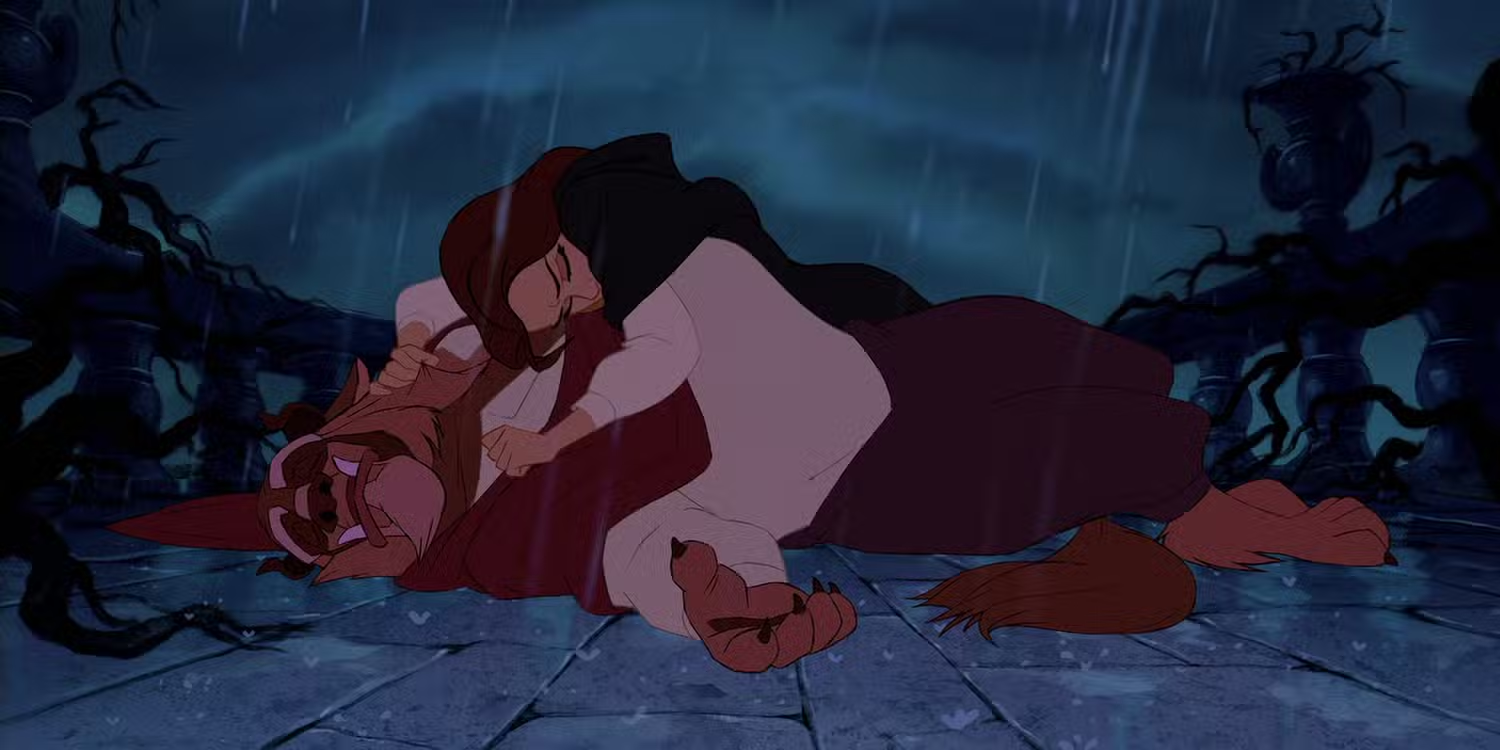
When the Beast screams at her to get out, through a loud, guttural, shout from the back of his monstrous throat, she does. She reneges on the deal she just made with him and rushes away from the castle to go back home to her father. She most definitely wouldn’t have come back if she weren’t attacked by wolves and then had to be saved by the Beast. The action of him saving her life was what prompted her to then try and save him in return.
Of course, that didn’t lead to instant love. Back at the castle, the two get into an argument. It’s portrayed in a much lighter manner than the earlier scene where the two interacted. Before this scene, Belle was very clearly scared and the Beast was always either towering over her or cloaked in shadow.
Here though, the scene transitions to something more relaxed. The Beast is in pain as she nurses the wound on his arm but she’s sitting at near eye level with him to do it. The harsh, cruel darkness that followed him around is kept at bay by the light of the fireplace. When the Beast starts to verbally admonish Belle for the pain her treatment is causing him, this time Belle fights back. The two have a back and forth rather than a one-sided takedown.
The scene works as well as it does because it manages to re-establish the Beast’s character not only to Belle but to the audience. It's the first time in the film where the Beast is being portrayed as strictly human, despite his appearance.. Of course most of the earlier scenes where he was looming over her and looking scary was a put upon act. He’s screaming and angry because he’s frustrated and depressed. He hides in the dark not to look scary but to hide himself because he fears being judged for how he looks.
As a result, the Beast’s vulnerability is made known and it puts him in the position of someone not really dominant or in control of their situation. He’s just someone in need of help and in need of a friend. His act of kindness and his opening up to her finally gave Belle a reason to respond positively to him.
From that point forward, he comes off more as this goofy animal for the rest of the non-dramatic parts of the movie. Actually, this comes into play even before the scene where the two properly open up to each other. To Belle, he’s scary. However, to his servants, this is just who he is. They’re not as terrified of him so his scenes speaking with them are allowed to be a little more humorous. Due to this, the scene where he’s trying to convince Belle to come to dinner is comedy gold. He has no idea how to properly talk to a woman and the facial expressions he makes when she keeps refusing his pathetic attempts at advancements and doesn’t immediately acquiesce to his demands are hilarious.
When he’s finally had enough and shouts “THEN YOU CAN GO AHEAD AND STARVE!” it comes off as more funny than scary because it has the air of a whining child rather than a tough, strong monster. The way Mrs. Potts, Lumiere, and Cogsworth react to it just puts emphasis on that.
The fact of the matter is that Belle doesn’t take any of the Beast’s nonsense .
She isn’t developing positive feelings for him to survive. There’s nothing for her to survive at this point in the film. She escaped and came back of her own accord to be nice to someone who was nice to her. She only reacts positively to the Beast when he reacts positively to her. The Beast needs to earn her trust. Then earn her friendship. And eventually, over the seasons, earn her love.
But when he’s wrong or angry, she fires back. Even at the start when she was the most afraid of him, she kept refusing to do what he demanded because he wasn’t being nice about it.
Of course, on the flip side, if the Beast was an actual scary guy or an abuser this method wouldn’t have worked. He wouldn’t have eventually realized that he was the problem and tried his best to change and fix himself up for her.
The hired help are some of the most supportive and fun characters in the film and that’s also by design. Lumiere and his french madness soak up the screen with a pension for being a massive showman and extremely attention hungry. Cogsworth being his stuck up sidekick who gets the short end of the stick all the time despite doing his best to remain as dignified as a clock can be, has a rapport with Lumiere that’s just fun to watch. Then there’s the lovely Mrs. Potts and her son Chip. She’s got a wonderful voice and motherly personality. Meanwhile, Chip’s adventurous and cute spirit is not only adorable but ends up being crucial to the climax of the film when he helps Belle and Maurice escape from their real villain imprisoning Belle.
Gaston.
Well, I say Gaston but it’s more so the town itself. Gaston is, in a sense, the ultimate culmination of what the town is. He’s the byproduct of everything bad about it and the final form of what it can and ultimately did produce.
His presence in the film stands in direct opposition to the Stockholm Syndrome myth. It’s no wonder he hardly ever gets mentioned whenever this bad faith argument is brought up.
Gaston is the opposite of the Beast in every way. He’s pretty, he’s brawny, he runs on pure toxic masculinity, and he fights dirty only to die by falling off the top of a huge castle. The alternative was to admit to himself that Belle isn’t a possession.
To be blunt, he probably would have said he’d rather die than admit to there being anything kind and gentle underneath his bulky exterior. He’d probably be correct to assume that too. Intentionally, there is nothing underneath there. Gaston wears everything about him on his sleeve. He has no reason not to.
There’s no one as awed or as admired as him. He’s everyone’s favorite guy.
And that’s the problem.
Belle is singled out by the people of this town for being weird and strange. She hungers for adventure and is studious in a way that most people aren’t. She really likes books and yearns for adventure out in the great wide somewhere but Gaston sees her reading one of those disgusting books and tosses it into a mud puddle, genuinely thinking he’s doing her a favor by instead trying to refocus her attention on the idea of marrying him. He even literally says that girls learning to read is a bad thing. Next thing you know they’ll start having ideas and “thinking”, he states. Oh the humanity.
The Beast surrounds himself with people like Lumiere, Cogsworth, Mrs. Potts, and Chip. It’s no wonder he’s still got a spark of humanity within him. Conversely it’s no wonder Belle feels so isolated. Just like in any society, there are some good people in the town.The man who let Belle keep her favorite book at the library is a stand out example of a good soul who values Belle and her love of reading. However, people like him aren’t the norm here and despite that she’s still desperately in need of someone who would just take interest in what she has to say without heavy prompting.
So when she meets the Beast and he legitimately does, it probably felt incredible. The scene where she gets done reading an entire book to him and he wants her to read it again is adorable. Then, she asks him to read it to her and he sadly admits to not being able to read. So she starts teaching him. A genuine connection is being formed here. The two are learning more about each other and using their strengths to fill the gaps of the other’s weaknesses and in turn making each other stronger individuals.
The scene beforehand where the Beast, extremely happy and excited to see her reaction, gifts her his entire library might be one of the best scenes in the film. It’s a gesture so sweet you’d be in danger of getting cavities just from watching it.
Contrast this to Gaston who literally puts his muddy boots all over her book while trying to force her into a marriage he decided was already going to happen before he even proposed. He plays it off like a joke and the people in this horrible town just laugh along with him.
So when he gets rejected, he can’t understand it. He’s mentally unable to get why she keeps rejecting him. The fact that she does is probably the thing that’s pushing him to go after her more and more, despite there being so many other beautiful women in town who would gladly be Gaston’s trophy wife.
It’s the allure of something he can’t have. She’s constantly saying no to someone who is always said yes to. He always gets what he wants and if he can’t have her then what does that mean? Clearly it means he’s being challenged and as a man he needs to rise to the occasion and do whatever he has to in order to claim Belle as his own.
Not as a person but as a literal prize to be won. Someone he can snag just so he can say “I did it. Belle is mine.”
That’s part of the reason the upbeat Gaston song is so vile and heinous. It kicks off with such a horrible, creepy undertone. The musical lead in feels so underhanded that when it fires off with all its bluster it really sells the celebratory scene as something it’s not.
The themes of the film and what it’s utilizing the Beast and Gaston to show a contrast for is on open display. The only way anyone wouldn’t acknowledge it is if they completely lack literary and visual comprehension or they were just trying to act as if they’re smarter than the film.
To claim that the relationship Belle forms with the Beast isn’t genuine parallels the act of taking a magnifying glass to the film’s seams to see what you can tug and pull at in order for it to unravel. There are things that have aged badly where a method like this is plausible but one should never try to force a controversy where there isn’t one. It dilutes what’s actually there and poisons any conversation you might want to have about any work of art set before you.
Something magnanimous and wonderful happened when Beauty and the Beast came out that managed to enchant so many people. It shouldn’t have been a controversy that it was nominated for best picture of that year because it deserved it. It shouldn’t be a controversy that Belle fell for the Beast in an appropriate manner because it isn’t.
These are bad faith arguments. It’s a sad phenomena that tends to happen when something is considered too beloved and too praised. Whatever sits on the mountain needs to be pushed off by the dregs below it who could never understand nor create art that strives for the peak in the same manner.
Despite what people will do to put the film down for what it achieved, it’ll live on. Even Disney’s own attempt to disgrace it with their live action hogwash didn’t destroy what’s beloved about the original and it’ll continue to be that way.
The Noise of the Fanbase
The internet has been around for most of my life at this point. I’ll always love being online. I’ve met many glorious people and have gotten to partake in a great amount of fun activities from several different communities. To say it’s not something to value and appreciate would be an obvious lie.
However, one thing I’ve learned spending countless hours online is that I should be partaking in far less of it than I do. Recently, I’ve found myself taking steps towards reducing what I’m exposed to. However, the nature of the internet as it exists today, has made that a burden in and of itself. The act of trying to avoid things can be almost as stressful as the content you’re attempting to dismiss.
One thing I’ve become extremely aware of as I start to get older is just how bad my negative bias has gotten. “Helpful” advice from those fortunate not to have a brain wired the way mine is was something along the lines of telling me to dive deep into all the negativity that I see. If I do then surely it will toughen me up, I was told.
I speak from experience when I say that’s nonsense. Maybe breeding familiarity with what ails you is a good way of becoming aware of what may be coming your way as far as hearing things you don’t want to hear. When it comes to dulling the sting of hearing it, that’s never happened. I’d consider the ability to close off your emotions to the negative news and reactions you catch while doom scrolling to be equivalent to getting a wish granted by a genie.
I used to frequent a lot of fan sites. It took me a while before I dove deep into social media but I eventually got along as best I could with it as well. It was fun and fascinating at first. Due to the inherent hugeness of the internet, social groups would form in pockets on several websites and you could discuss the things you were enamoured with there with other likeminded individuals. Twitter feeds, Reddit forums, or a singular website dedicated to just one fictional series were strung about the web, just waiting for you to dive in and make your opinions on your favorite thing known.
In some cases, being in areas where you share a similar interest in something would naturally lead to comradery amongst your peers. It probably led to that happening far more often then it didn’t and I’m just unable to acknowledge it because of just how overwhelming the negative experiences were.
For even amongst your peers within a fanbase based around something you love, you’ll find a torrent of hatred and contempt.
It was astounding baring witness to that for the first time and as the years went on and never got any better, I found myself wondering why?
Well, in order to approach an attempt at understanding this it might be pertinent to look into the specifics behind an example of a developing fanbase and how it changed over the years. It would do so naturally but because things within the targeted series changed so rapidly, it led to a lot of conundrums for folks who liked things about it being a certain way.
There is a video game series called Sonic the Hedgehog, named after the fast footed, titular blue animal character. Over the years his games have changed dramatically. They began in 1991 as a 2D sidescrolling platformer and by 1999 when the advent of 3D came about, the platforming was straightforward within a wide open 3D landscape. As generally well-received as the jump to 3D was, with the title Sonic Adventure, and its even more celebrated sequel Sonic Adventure 2, the shift from the 2D games that laid the foundation of what the series was to what it will be in 3D was not that long.
To a child it would certainly seem like it was long though. Everything was longer when you were a child. Becoming acclimated to the train of time is something our minds only manage to do as we get older. It makes sitting in class a slog but as an adult you’ll find yourself wondering how it’s already more than half way through the year numerous times while at your desk.
As a result, the gap in time from 1991 to 1999 isn’t as paltry as one may be led to think. If you played the first Sonic game when you were 10 then you were 18, an adult, when Sonic Adventure came out. All of a sudden, the video game series you recognized as a 2D sidescroller throughout your entire childhood no longer was. Compartmentalizing the idea that you’d likely never see another Sonic game of that nature again would have been expected.
It wouldn’t have been true but what’s new is scary often because we’re unable to see what lies beyond it.
Skip ahead to 2001. All of a sudden, SEGA, the video game manufacturing company that makes the games for your favorite series, announces that it will no longer be creating video game hardware. The reasons why this happened don’t have anything in particular to do with Sonic itself but Sonic, being SEGA’s mascot, is heavily affected by this anyway.
The shift in expectation from SEGA is suddenly on the floor. Now, your favorite video game series isn’t making any new 2D sidescrollers and the company that made the hardware you played those games on is no longer making that hardware. SEGA has now become a full third party publisher, meaning, it makes games and sells them onto the consoles created by the folks that used to be its competition. This includes Nintendo, the up and coming Microsoft X-Box, as well as one of the contributing factors to their downfall, the Sony Playstation.
In 2003, they create a new Sonic game for all three of those platforms called Sonic Heroes. It becomes the best selling 3D Sonic game not only of that era but for almost 20 years. Why? Well, it was the first multi-platform Sonic game ever made. For the first time, people could play a Sonic game without purchasing a SEGA console to do so and that made it an alluring project.
However, there was another issue. While the game also received positive reception it was yet another change in the dynamic of how the Sonic games were structured. This game had a three person team mechanic to it that allowed you to take control of three characters at the same time.
Good or bad, the take away here is how different it was. In just the span of two years so much has changed. You’d likely have no reason to assume the team mechanic was going to stay a feature of the Sonic games to come and you’d be right but so much else about the series and everything around it has changed too.
The first Sonic game only had two prominent characters, Sonic the Hedgehog and Dr. Robotnik. Now, the latest game featured four teams of twelve different characters each with their own different relations to Sonic. Tails the Fox is his best friend. Shadow the Hedgehog is his gloomy rival. There’s a group featuring a crocodile, a chameleon, and a honey bee whom together run a detective agency. These three don’t even properly interact with Sonic within the game.
On top of that, you’d likely already be dealing with the other swift change that happened once Sonic made it to the third dimension. His design was altered. All the designs of the existing characters were changed and while they've become iconic and a staple of what modern Sonic is nowadays, back then there’s reason to believe that seeing them might have been shocking.
Voice acting is another area in which things would likely put you off if you saw Sonic as a character that didn’t or shouldn’t speak. Even if you saw those old Saturday morning cartoons where he was voiced by Jaleel White, you likely wouldn’t have associated that with your ideal version of Sonic because those were just hastily scrapped together animations made to sell the games to you.
What about storytelling? The manuals in the 2D Sonic games had blurbs that told you who the characters were and their motivations but now, all of a sudden, you have fully rendered cutscenes complete with that voice acting we were talking about earlier that’s being utilized to tell a complete narrative. Some narratives even had widely inconsistent tones.
Sonic Adventure had a fairly even tone. Sonic Adventure 2 delved into much darker themes towards its end game that dealt with a plot centered on mad science gone wrong. The military was heavily featured within it. Guns were abound and death was talked about freely and openly as a motivation for one of the characters wishing total annihilation upon the world.
Yet in Sonic Heroes, the tone shifted yet again, to be far more simplistic. All of a sudden the colorful cartoon animals were acting like they were in an afterschool special and Sonic was galavanting along about the superpower of teamwork.
The very next game after that, in 2005, you’d play as Shadow the Hedgehog in his own title. It’s a game that’s highly credited as being the reason the E10 and up rating was created. It’s an extremely dark game. Shadow routinely fires machine guns and pistols. He kills aliens. Death is rampant and there’s even mild cursing in it.
It’s only 2005 and already there’s an abundance of different things that newcomers and veterans to the series alike have to talk about.
The gameplay is different. The characters look different. The tone is never consistent. Some say there are too many new characters. Some say the characters they grew up with are becoming obsolete. It was hard navigating through it all because I often felt like I was on the backburner for all of it.
That’s because the demographic I was witnessing complaining about all this stuff wasn’t my generation. My generation wasn’t prominent enough online yet. When they did eventually become more prominent online, that’s when I would start to see defenses for the things about Sonic that I grew up with and liked.
All of a sudden, there was newfound love for the 3D games, for the characters, for the voice actors, and for the darker tone of some of the narratives. Why? Because those stories and games had been what we, the newer generation, had grown up with.
What Sonic was to us was completely different from what Sonic was to them.
That didn’t stop being the case either. You could even argue that my generation ended up becoming the most neglected within the Sonic series despite it arguably being the most important. After all, my generation was the one that made Sonic Heroes their best selling 3D game.
Yet, they pivoted a lot in a brazen attempt to try and appeal to what they believed was Sonic’s heyday while still keeping a minor hold on the changes that made him who he was currently. It was a banal and lazy attempt and the era this ushered in for the fans didn’t make either of the existing camps happy.
However, every new game is someone’s first. So even though the newer games from the 2010s weren’t appealing to most already within the base, they were appealing to the newcomers that saw them, played them, and formulated their own vision of what Sonic was.
This was the true problem with the series. Naturally, things will change the longer a series exists. It’s inevitable. However, the pivots that the Sonic series would often make were so drastic and often completely unnecessary that it did very little but frustrate at the time. An audience that couldn’t vocalize their love for the content being created due to being too young was brewing under the surface yet again and as the years passed, they would find their voice and it would be added to the pile.
The voices were all shouting out for different things. We all knew what we wanted as individuals but because we all wanted different things, a stigma started going around that proclaimed that Sonic fans didn’t know what they wanted. In a sense that’s true. Collectively, we didn’t because we weren’t a singular unit of people. There is no such thing as a hive mind but the fanbase of a certain series is usually a lot better about vocalizing what it is they like about said series than the Sonic crowd was.
Experiences dealing with this online were not fun. It grew less and less fun as time went on and I find myself scoffing at the idea that indulging in more of it would somehow have made things better.
The example I gave is admittedly a rather extreme one but I feel it illustrates the point quite well. Despite being a fan of the same thing, comradery couldn’t always happen because too many people had too different an idea of what that thing even was.
There would be ascending opinions about things that were viewed badly by critics and dissenting opinions about things that were viewed positively by critics. Who were those critics? Which camp did they fall into and why? Skepticism on who to trust and why they should be trusted would come about because of this as well.
When the fanbase of anything splits this much it leads to a lot of bad faith actors crossing lines over trivial things. Today, even with things being a lot better, you’d routinely see people harassing video game writers, film actors, and comic book artists that had a hand in creating the things that you love. Minor details that didn’t matter such as a character saying a line you didn’t like, hugging someone they liked, or merely expressing that they felt a certain way were scrutinized.
Often, it would go as far as people attacking them over perceptions of their character they dreamed up in their head. They would call people they didn’t know narcissists or sexist while ironically acting that way towards the people they were harassing.
When it comes to the Sonic franchise specifically, it was all a bunch of noise and it was curated entirely by SEGA themselves. Most certainly it was unintentionally done but it’s the truth. No matter what anyone says about the fanbase for that series, it was entirely SEGA’s fault that things got so confused and messed up.
Yet there is a sense of inevitability to it as well. This is something that just exists within all fanbases. The Sonic example is a more extreme case due to the handling of that series amplifying what was already there.
But no matter what, people are going to have different opinions about the same thing. Two people could watch a Marvel movie and be a fan of the MCU but come away from that movie thinking two completely different things about it. When it’s tied to the movie itself it may not matter. But if it's tied to a greater whole, the MCU that they both love, suddenly whether or not the second person loved or hated the movie matters a whole lot more to you.
This leads to in-fighting and disrespectful behavior of all kinds. The soul of a series, any series, are its fans and if the fans are destroying one another then where does the series go from there?
It’s not something that I like to think about anymore so I’ve opted to be mostly done with it. However, there is still value in community. It’s something human beings all crave and I’m no different.
I have a group of people that I converse with about my likes and dislikes about certain things should the need arise and that’s it. It’s a small community but it’s friendly and full of folks that would never vilify someone for merely disagreeing with you on something. If they ever become that kind of person, they wouldn’t stick around for very long either.
I’ve often wondered if it were possible to retreat to the days of my youth and relive the happiness I once felt simply playing a video game or watching a movie without reserves of other opinions flooding my brain. The assertion that diving headfirst into the negativity will make you get used to it really does get more and more ridiculous the more you think about it.
When I was a child, simply indulging in what I loved, that noise wasn’t there. It was freeing. It was relaxing. It was the happiest I had ever been when consuming media.
I’m an adult. I can function just fine and shape my own opinions the way I wish. I’ll always have a soft spot for a healthy community of kind and likeminded individuals but I don’t need to stumble through the noise to enjoy things.
Not everything should be reacted to as though you were a child but I’ve found that the purity of simply experiencing and enjoying something for what it is rather comforting. We could all do with a little less stress in our lives. So instead of worrying so much about what other people think, enjoy what you know you love.
Your opinion isn’t any less important than theirs. I promise.
You’ll Own Nothing and Be Happy
Media preservation has been an increasingly hot topic in recent years and the conversation around it has only gotten worse as the days have gone on.
However, numerous things have happened recently that’s made that topic the prevailing conversation piece across the internet for weeks now.
On July 1st, 2026, Sony announced that they would be ceasing production on all physical game discs for their Playstation console in early 2028. This announcement completely shattered their social media outlets and flooded it with complaints. So many videos and articles were made outlining the fault in this plan of action as well as illustrating a sense of doom for the concept of owning your games.
What’s worse, this announcement came out right after Sony deleted over 500 purchased movies from the accounts of customers without warning. Complications with licensing being the excuse didn’t change the fact that money was exchanged under the guise of owning something and that something was taken away.
The precedent this sets is more than a little concerning. The idea of walking into a store, buying something, and leaving with it as its new owner is a concept that still exists obviously but it’s grown more and more obfuscated when it comes to media that can be consumed digitally. The film industry isn’t in as huge a bind as the gaming industry because they still sell DVDs and blu rays to customers.
However, Playstation is the most prominent video game distributor on the planet aside from Nintendo. Their ecosystem stretches far beyond that of what Nintendo provides due to being widely considered preferable for those who wish to have the best experience playing third party games. Nintendo is always a little behind on the times when it comes to hardware and they survive based on the pools of money they’ve built up over the years and their dedicated fanbase who’ll gladly opt out of the perks that Playstation provides should it mean they get to play the next Mario Kart, Zelda, or Smash Brothers video game.
There was a third player to this game vying for the attention of the gaming scene and it was X-Box, heralded by the leaders at Microsoft. X-Box is still around but the conversation around them has shifted to that of speaking as if they’re a shambling corpse. Even when there’s good news about X-Box it doesn’t stay that way for very long before something that makes you realize you should have known better comes around the corner.
Why is it like this? Ironically it’s due to the exact same thing that Sony is doing now.
Back in May of 2013, during a now defunct yearly gaming conference called E3, Microsoft was set to unveil their latest in innovative gaming technology. It was a new gaming console that was set to kick off the next generation of Microsoft for the coming years.
It was called the X-Box One. Why did they call it that even though it was their third system? Because the intention was for it to be an all-in-one system and they figured the name was cute. Realistically though, all the name did was confuse people.
To say that this presentation went badly would be a gross understatement. Even now, here in the year 2026, what happened during that year is still being called back to. Some would argue that it’s even more relevant now than it was back then.
The X-Box presenters did something unprecedented that day. They walked out on stage and instead of talking about video games they spoke about television. The words “TV” and “television” were used so much that compilations of how often those words were used flooded the internet in a matter of hours after the event ended.
So much time was spent on anomalies and little excursions from gaming that it not only made the presentation boring but it confused those who were there to watch it as to what X-Box was even doing. That’s because the presentation wasn’t for gamers. It was supposed to be an initiative that turned X-Box, in their own words, into “the next watercooler”.
They wanted their game system to be something that was in every household, workspace, theme park, and whatever else would hold it. They wanted it to be something that could be utilized for anything you, the consumer, wanted to use it for. They came out on stage acting as if they were presenting something that was going to go down in history as something essential to modern living like the smartphone.
Due to this, their presentation didn’t involve any games. The only one that they spoke about with any reverence was Call of Duty and the only notable thing people talked about there was the fact that you could partner with a dog.
The arrogance on display wasn’t just nakedly obvious. It was baked within the confines of the system itself. They had already been experimenting with selling people glorified tech demo devices such as the X-Box Kinect. It was supposed to be their answer to the Nintendo Wii game system. With the Kinect “you were the controller” or so their marketing so garishly stated. You would play games by moving your body in tune to a camera set up in your living room and when you made an action in real life, that action was supposed to be reflected in the game itself.
It was a disaster and universally maligned by everyone who tried it. Despite that, it was being sold with their new system. If you wanted the X-Box One you had to have it. That doesn’t sound like a bad deal on paper. Even if you had no intention of ever using it, having access to it meant having access to a ton of other games created for it. Surely one of them might pique your interest one day right?
Well, for a lot of people, that didn’t end up being the case. The reason being that this bulky, expensive technology that was included with your system wasn’t free. It marked up the price of the X-Box One by a full 100 dollars.
When the Playstation 4 was revealed that same day at a price that was 100 dollars cheaper than the X-Box One, it was over.
All of that was bad enough, but the largest contributing factor to their downfall was how they were going to approach connectivity.
The X-Box One was famously supposed to originally launch as an always online system. This meant that if you didn’t have a good internet connection you wouldn’t be able to play games on it at all.
There were a lot of obvious issues with this. Cutting away the part of your fanbase who have supported you ever since your first system was released for the sake of needing to control all the games you release for your platform is an extreme thing to do.
If you weren’t rich enough to have good internet access all the time, the luxury item you wanted to get away from it all from time to time did not have your back anymore. It did for their competitors in Playstation and Nintendo, but if you were an X-Box fan and your internet was spotty they were abandoning you and they didn’t care.
This issue also extends to people who game in areas where the problem isn’t necessarily a lack of money but a shift in what’s typically expected in daily life. Folks in the military tend to play video games a lot and when you’re in the barracks or on a nuclear sub you’re not going to be able to connect to the internet easily or even at all.
However, the biggest issue was media preservation. If all your games are online only then you don’t actually own any of them. You can’t physically own something you bought that doesn’t come in a physical form. Instead, what was expected was that you’d buy their games and they would sit on the X-Box One console at the mercy of Microsoft.
Meaning, should anything happen that necessitated they get rid of the product you bought, you would have no recourse. They could just get rid of it and you wouldn’t be able to do anything about it. It sounds ridiculous and that’s because it is. Unfortunately, that didn’t make it any less real.
Don Mattrick, X-Box’s CEO at the time, responded to the backlash in a way that could be described as career ruining. He didn’t work at X-Box for very much longer after this but he dropped the number one quoted gem associated with X-Box at the time of this reveal and beyond.
“Fortunately we have a product for those who can't get some form of connectivity. It's called Xbox 360.”
The man responded to the backlash by saying that if people didn’t like that their system required them to always be online then they need only purchase their previous, soon to be obsolete, console, the X-Box 360 to mitigate that.
It was an incredibly strange angle to take for a company that was trying to sell the world their new gaming console. Especially since their competition was also releasing a console that didn’t have these problems. Japan is a huge bastion for gaming and they already didn’t care about the X-Box. It wasn’t a good move to make the entire rest of the world angry at you and that’s proven by the fact that the X-Box One undoubtedly lost that generation.
It’s not even something that’s up for debate. It’s known across the entire industry. The X-Box CEO that replaced Don Mattrick, Phil Spencer, even went on to call the X-Box One generation the worst generation to lose for them.
Because the advent of digital media was kicking off so hard around that time, people had built up a huge reservoir of media libraries that they didn’t want to part with. When it came time to jump to the next consoles, the ones who were already baked into the ecosystem of Playstation were likely going to stay there to preserve that. Because so few stuck with X-Box and X-Box did so little to provide alternate reasons to purchase their console, they had nothing to rely on for people to buy back in.
Then everything got worse with the sky hiking prices of RAM this year. Due to the issues with data centers making components exponentially more expensive than they should be, RAM, the product these gaming consoles need to function, has sky skyrocketed in price. As such, the components needed to make and sell them have also gone up by a wide margin.
In recent months, it’s been impossible to be online and not stumble over an article or post talking about some new price hike. X-Box has had three in just the past two months.
Now we cut back to the Playstation of today and they’ve decided to take a page from X-Box’s book and do the exact same thing that caused their downfall so long ago. However, so much has changed since 2013 and it’s looking more and more likely that they made this move because they knew they’d be able to get away with it.
Sony is a company. They’re not your friends. They certainly wanted you to believe that back in 2013 when Microsoft boldly stated with their full chest that they hated their audience though. What happened to Microsoft was the greatest thing that could have ever happened to Sony.
When Sony’s presentation happened in 2013, then CEO Jack Trenton, got on stage to simply say that on the Playstation 4 you could share physical games with your friends, they didn’t require you to be always online, and that no harm was going to come to the used games market for those who couldn’t always afford to buy something new at full price.
They made a video where they demonstrated how to share your games with Playstation 4. It was an adorable short clip of a man handing another man a game and being thanked. That was it.
They got so much style points and prestige with their audience that things that were expected to already come with video game consoles were being loudly cheered at and celebrated. They were in paradise.
As of July 2026, Sony has decided to stop selling physical games, are requiring you to always be online to play them, and are gutting the used games market. There will be no discs to share with your friends. If you can’t afford games at full price, that’s too bad. Not only can you not get them used anymore but the prices of regular video games have gone up a full 20 bucks thanks to the pricing of Mario Kart World. When Mario Kart did it, it told the industry it was okay for the rest of them to do it. Suddenly rumors began floating around that Grand Theft Auto 6 was going to now be 100 dollars.
Then the pricing was announced for Grand Theft Auto 6, a new entry in the most influential video game series on the planet. People who don’t normally play video games will buy consoles just to play this game.
It was priced at 100 dollars. They’ll say it was priced at 80 dollars and that the 100 dollar version is a special edition but they know that’s not true. In order to ensure you buy the 100 dollar version they took away access to certain things within the base game to make sure you have a worse time and less content than the people who shelled out the full 100 dollars.
The game costs 100 dollars.
So what changed? Why did Sony suddenly take the plunge in this direction when it went so disastrously for Microsoft? A part of the reason why has to be because Microsoft was no longer a threat.
Sony never needed to worry about Nintendo. Despite still being their direct competition, their demographics were too different for the overlap to be concerning. Most people who owned a Nintendo console also owned one of the other two consoles for the sake of playing third party, non-Nintendo games. No one bought Nintendo consoles to play things on it that weren’t made in house by Nintendo. If you wanted to play that other stuff, you needed either a Playstation or an X-Box.
Now that X-Box is essentially out of the equation in most people’s eyes, Sony can comfortably do what these companies always wanted to do without fear of you going to their competition to soften the blow. You either continue to buy Sony’s products for exorbitant prices or you go to X-Box for just as expensive hardware, less games, and let’s face it, an eventual pivot to what Sony is currently doing. The very thing they tried to do, they’ll try again. When the person whose winning is doing something, what do you do to survive? You copy them.
It hasn’t happened yet but trends are pushing in that direction. Physical copies of video games haven’t been purely physical for a long time at this point. Most get put in the system and still need a lot of things to be downloaded onto the disc before they’re ready for play.
Grand Theft Auto 6 being announced to have no physical game disc but a code in a box that’ll be on store shelves sounds silly and innocuous but it’s being done that way so that the consumers walking out and about will still see reminders of that game’s existence out in the wild. It’s not even something that Grand Theft Auto started. Nintendo pushed that with their overpriced Nintendo Switch 2 system and their use of digital keycards.
The industry no longer wants to sell you anything. They just want your money. They’ve always wanted your money but now they’ve taken things a step further into not wanting to give up anything to get it.
So long as the games are tied to their systems, you don’t own any of what you’re purchasing. It can be taken from you at a moment's notice and has been numerous times. Servers for games of old have been reported as being shut down as recently as a few days before the time of my writing this. Anyone who wants to go and play those games in the future just can’t anymore.
If you spent upwards of 60 dollars on a video game and paid extra for cosmetics within that video game, you’re going to feel cheated and slighted when that game gets shut down and inaccessible. It’s not something anyone is ever prepared for despite how much worse and prominent the issue has gotten.
The backlash to Sony’s decision has been magnanimous. It’s been so bad for them that their social media accounts haven’t posted anything gaming related for six days and anything they post on their other socials related to films are being flooded with comments demanding they bring back physical discs.
I admire the effort and the internet’s willingness to stand up to the advent of the oncoming apocalypse like this but Sony’s already invested too much money in this. They’ve already reported spending tens of millions of dollars changing their factories and reassigning workers to other positions within the company. This isn’t something they’re planning on doing. It’s already happened.
That said, it puts them in a very interesting position. If the consumer decides to do what they did with Microsoft and refuse to opt in, that’ll leave Sony in an even worse place than X-Box was at the time. X-Box merely needed to make the game discs they were still selling usable in order to fix the issue with the X-Box One. However, Sony isn’t selling any discs now. There is no way to fix this problem unless they want to spend another set of tens of millions of dollars reopening and restructuring their factories back to the way they were.
If the consumer wishes to put their money where their mouth is, now is the time. The future is bleak but there is and always has been hope. These companies need us to function. We outnumber them by an insanely wide margin. That’s why these attempts to syphon away control from the consumer over the products they should rightfully own are so antagonistic. They know they’d be nothing without you and they want to wrestle as much control away from you as they can so that you’ll have no choice but to acquiesce to their demands.
It’s terrible but the silver lining is that this has failed them before. The X-Box situation is proof of that. There are numerous other examples of it failing in other areas of the industry as well.
We can fix this so long as we resist the temptation to appeal to our desire for instant gratification. I’m willing to try. I hope you are too.